-
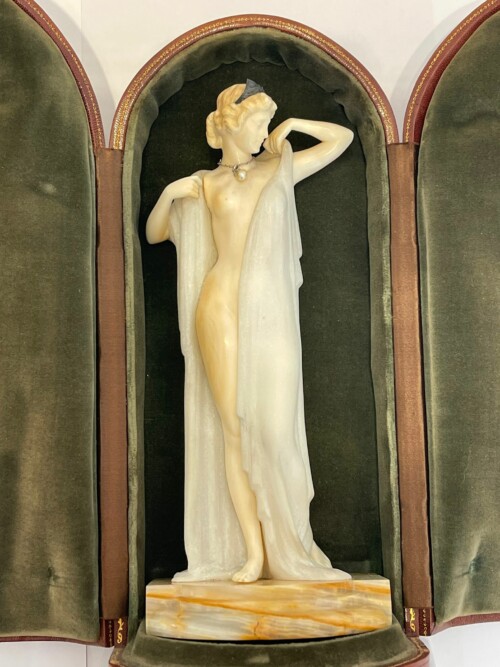 Ernst Seger (1868-1939) Sculpteur d'origine polonaise, formé à l'Académie des Beaux-Arts de Breslau auprès de Christian Behrens, il complète sa formation en 1893 à Paris dans l'atelier d'Auguste Rodin. Il s'installe ensuite à Berlin et devient l'un des représentants notables de la sculpture chryséléphantine, technique remise au goût du jour à l'époque Art déco, associant bronze doré ou marbre et ivoire, une mode qui a périclité après la Seconde Guerre mondiale, entre autres à cause de la production en série. « Phryné » Circa 1920 : Sculpture en ivoire symbolisant une courtisane vêtue d’un long peplos drapé en marbre, dévoilant sa poitrine et une partie de son corps. Elle porte un collier orné d’une perle et est coiffée d’un diadème ; base à gradins en marbre onyx. Signée en bordure de base « E. Seger ». Dans son écrin d’origine de la boutique Wegelin à Lyon, en cuir cognas capitonné de velours vert à l’intérieur. Dimension : H : 22 cm, H : 8 5/8 in - Ernst Seger (1868-1939) A sculptor of Polish origin, trained at the Breslau Academy of Fine Arts under Christian Behrens, he completed his training in 1893 in Paris in the studio of Auguste Rodin. He then settled in Berlin in 1894 and became one of the notable representatives of chryselephantine sculpture, a technique revived during the Art Deco period, combining gilded bronze or marble with ivory — a fashion that declined after the Second World War, partly due to mass production. "Phryné" Circa 1920. Ivory sculpture depicting a courtesan wearing a long draped marble peplos, revealing her breast and part of her body. She wears a necklace adorned with a pearl and a diadem headdress; tiered base in onyx marble. Signed along the base edge "E. Seger." In its original case from the Wegelin shop in Lyon, lined inside with green velvet padding. Dimensions: H: 22 cm, H: 8 5/8 in

